Glossary
Thirty-four terms from underwater robotics and ROS 2 mission data. Each one is defined three ways — the technical definition, a plain-English version, and what the thing is actually used for — and each carries a full infographic panel.
Click any term name to open its ▣ infographic — a full diagram of the concept. The same definitions appear as pop-up cards on the dotted terms throughout the field guide.
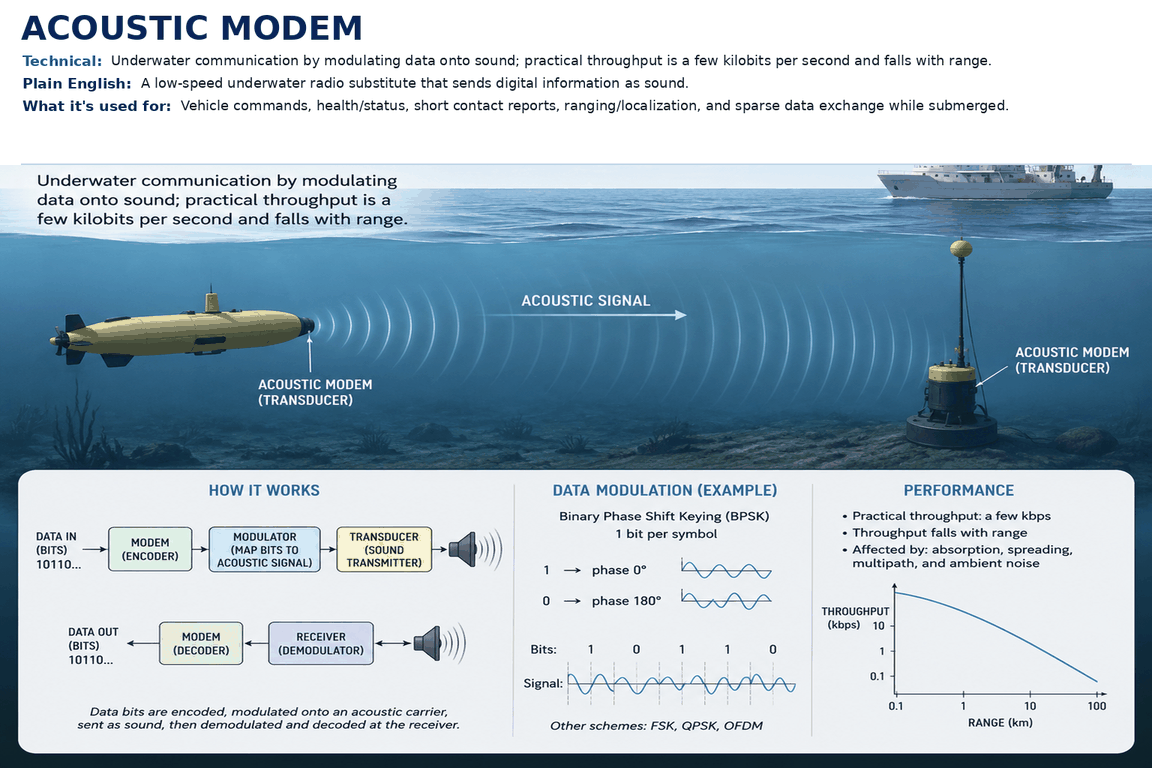
acoustic modem
Technical
Underwater communication by modulating data onto sound; practical throughput is a few kilobits per second and falls with range.
Plain English
Texting by underwater sound — a dial-up modem made of clicks, and slower.
What it's used for
The only live link to a submerged vehicle: fits status reports and tiny detections, never imagery.
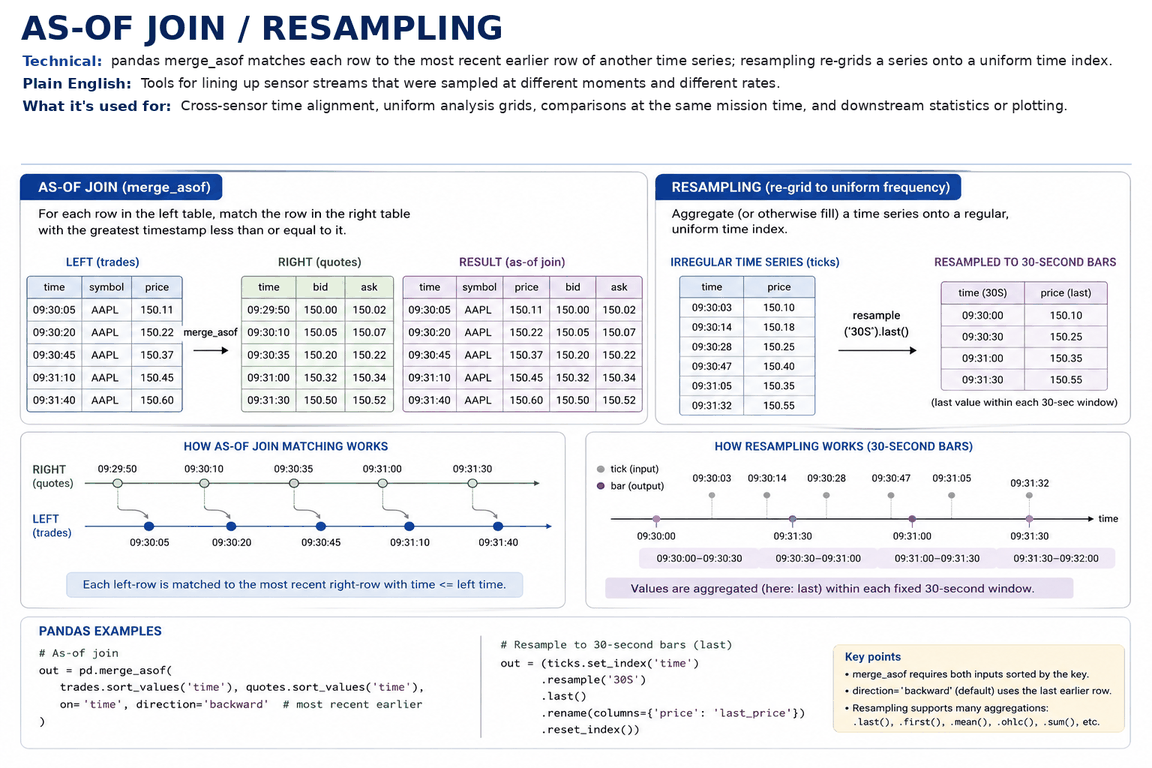
as-of join / resampling
Technical
pandas merge_asof matches each row to the most recent earlier row of another time series; resampling re-grids a series onto a uniform time index.
Plain English
Ways to line up measurements taken at different moments — answering 'what was the battery doing when the depth gauge read 40 m?'
What it's used for
The core maneuver for cross-sensor analysis of multi-rate data.
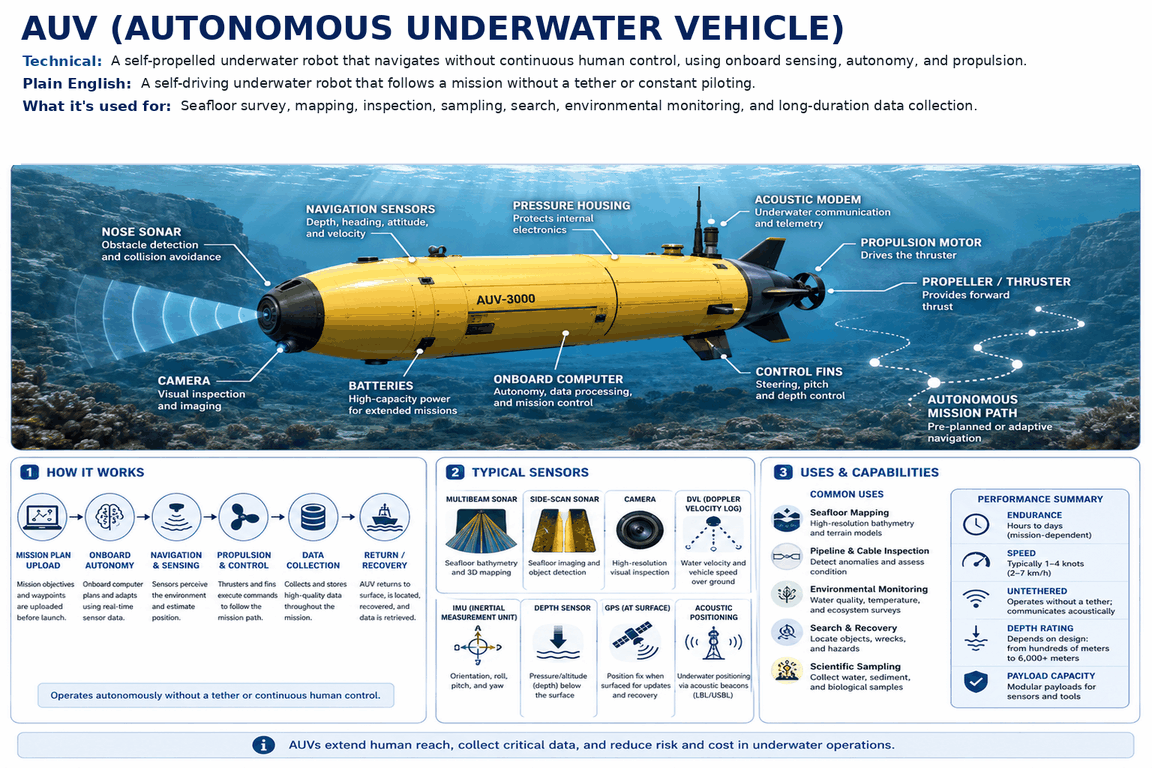
AUV (autonomous underwater vehicle)
Technical
An untethered marine robot that executes missions under its own control — in contrast to an ROV, which is tethered and human-piloted.
Plain English
A robot submarine that plans and drives itself for days or weeks at a time.
What it's used for
Ocean survey, infrastructure inspection, and defense missions too long, deep, or dull for crewed platforms.
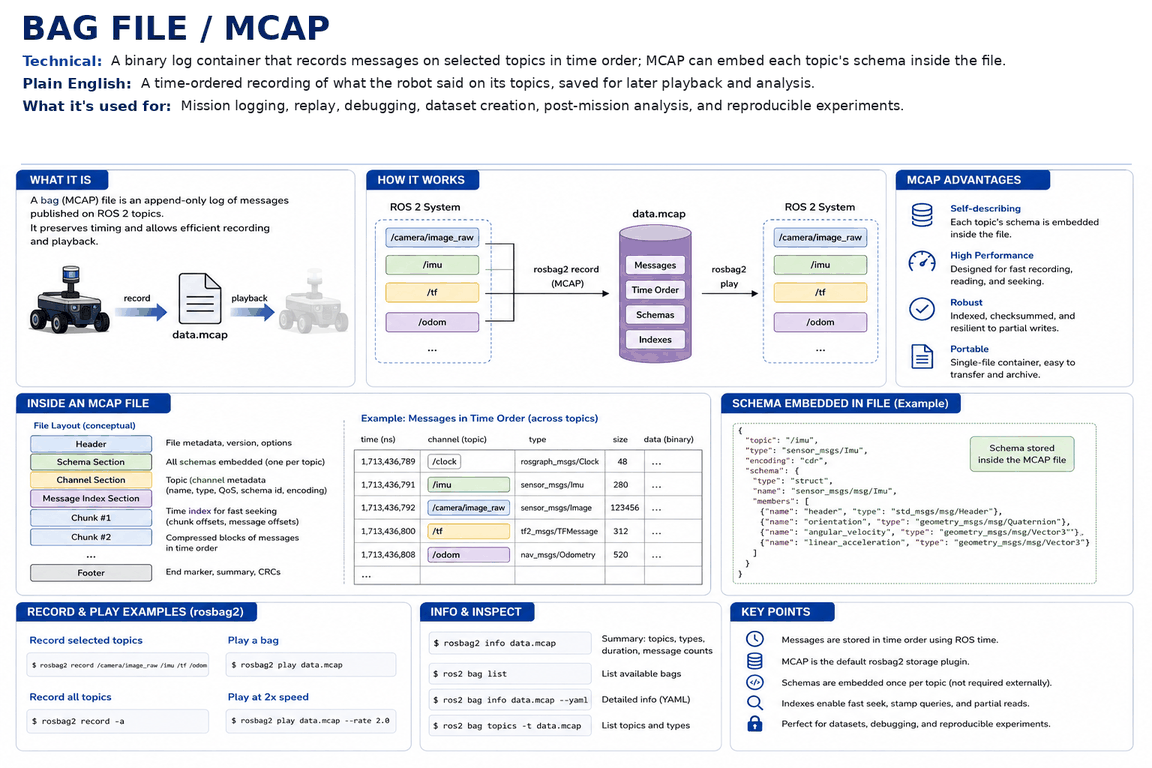
bag file / MCAP
Technical
A binary log container that records every message on selected topics in time order. MCAP, the current rosbag2 container, embeds each topic's schema inside the file.
Plain English
The robot's flight recorder — one file holding everything every sensor said, in order, plus its own decoder ring.
What it's used for
The raw material of all post-mission analysis.
BatteryState
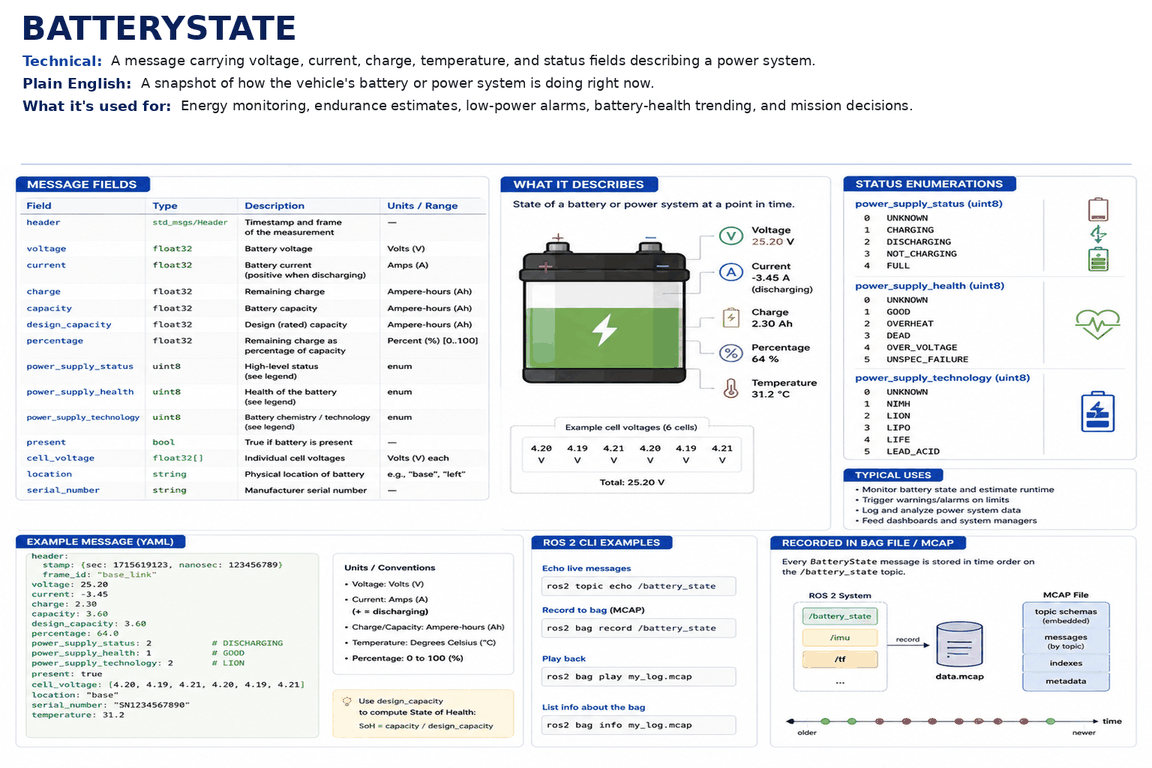
Technical
sensor_msgs/BatteryState carries voltage, current, charge, temperature, and status fields describing a power system.
Plain English
The battery gauge: how full, how hot, how hard it's working.
What it's used for
The heart of vehicle-health telemetry — for a fuel-cell vehicle, the answer to 'will it make it home?'
contact report
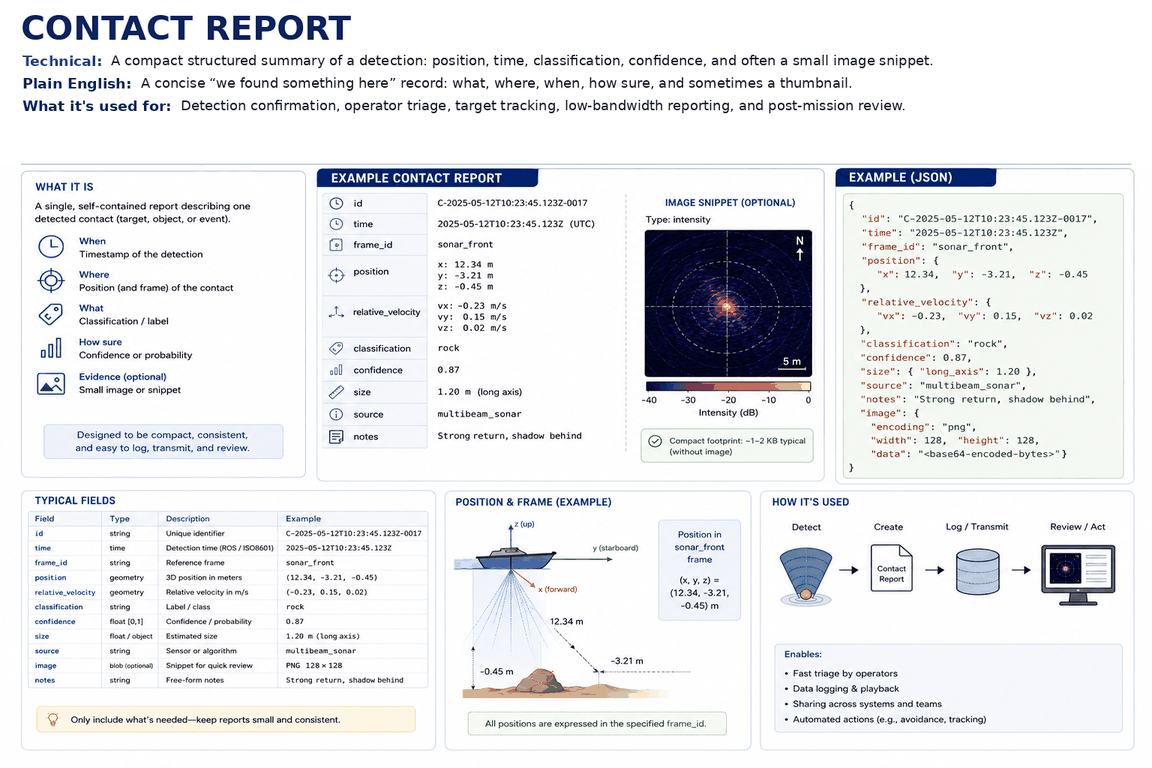
Technical
A compact structured summary of a detection: position, time, classification, confidence, and often a small image snippet.
Plain English
A sticky note saying 'saw something interesting, here, at this time — probably a wreck.'
What it's used for
Small enough to send over an acoustic modem; the operator's mid-mission window into what the sonar is finding.
covariance
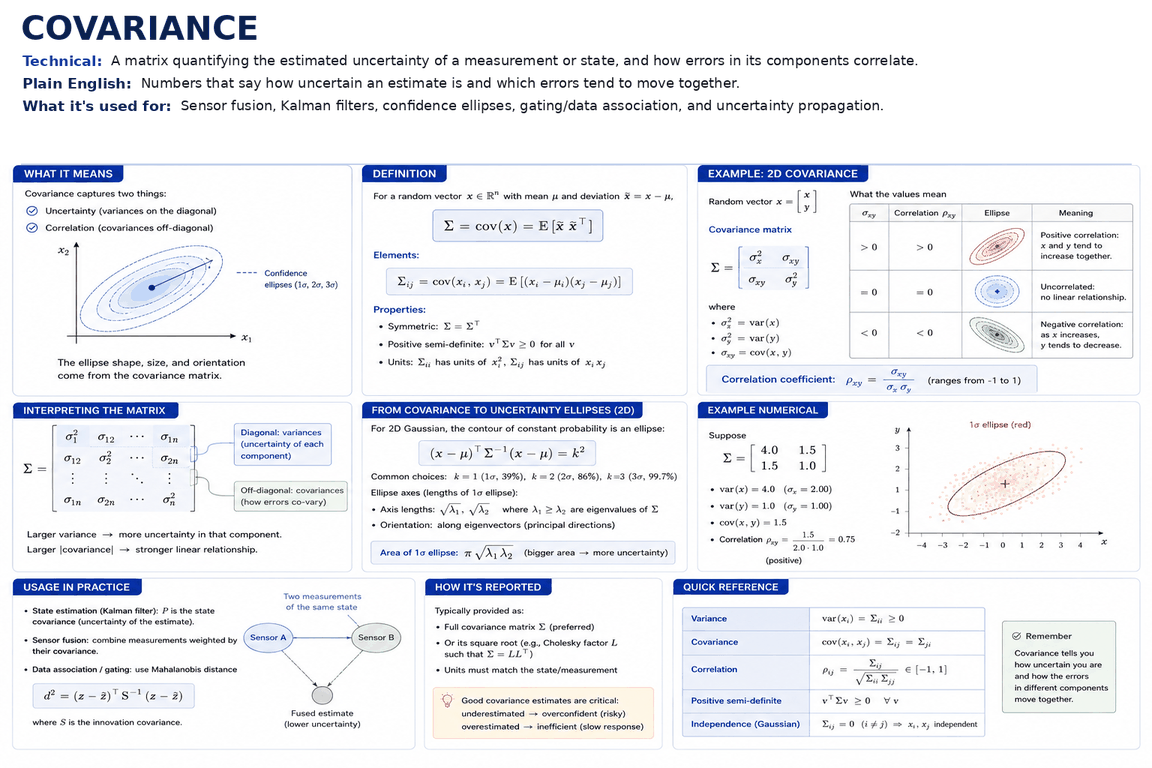
Technical
A matrix quantifying the estimated uncertainty of a measurement or state, and how errors in its components correlate.
Plain English
An honesty label attached to a reading: 'here's my value — and here's how much you should trust it.'
What it's used for
Sensor fusion weighs inputs by it; analysts use it to spot when the vehicle was navigationally 'lost.'
deserialize
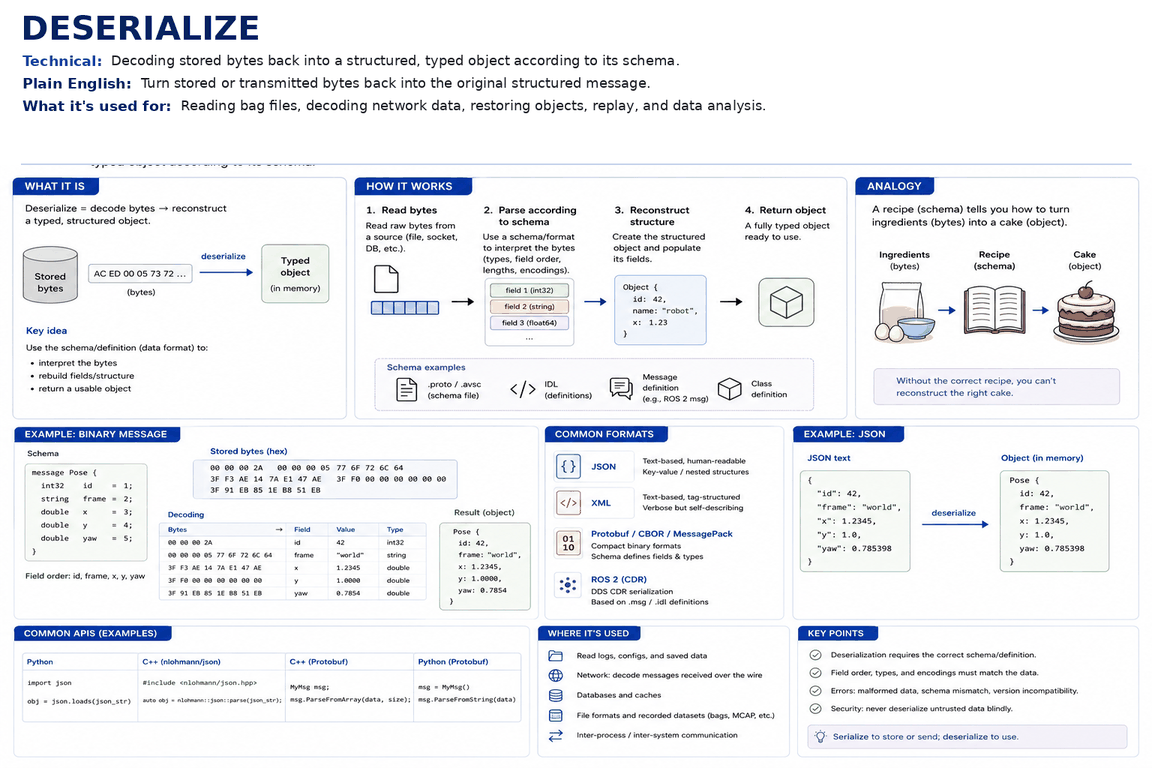
Technical
Decoding stored bytes back into a structured, typed object according to its schema.
Plain English
Un-flattening recorded bytes back into named numbers you can compute with.
What it's used for
The first step in reading any recorded message.
DVL (Doppler velocity log)
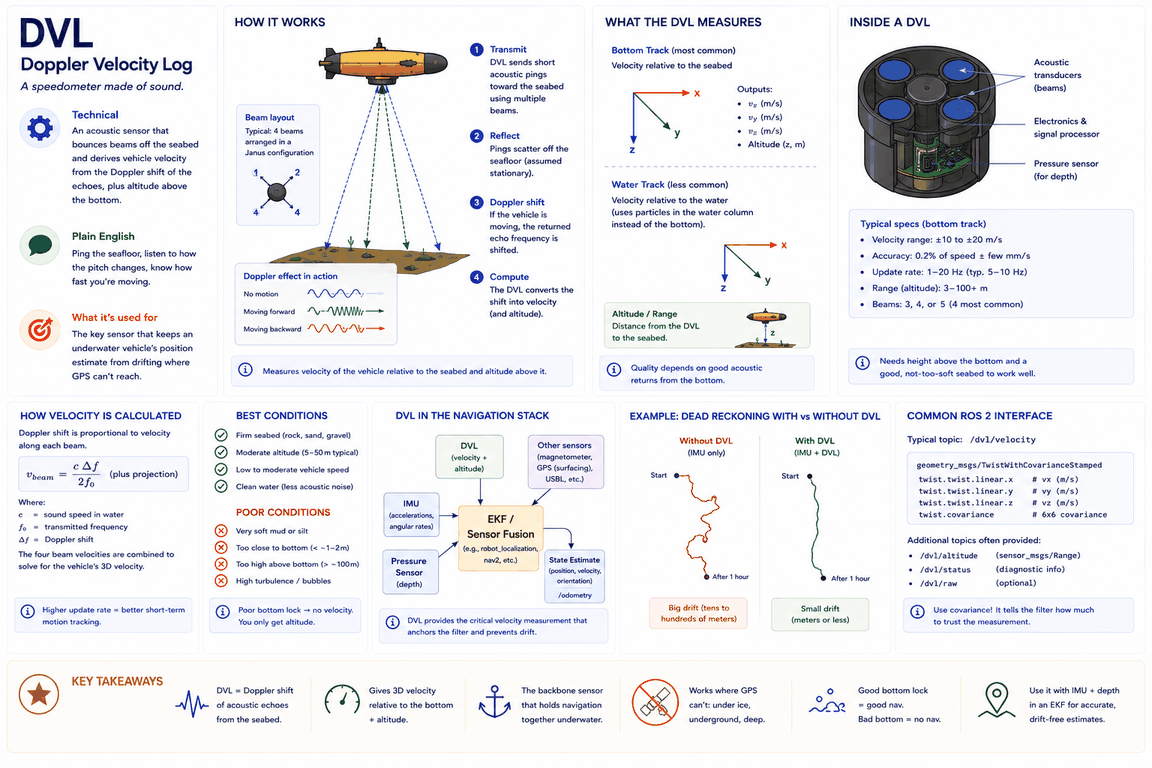
Technical
An acoustic sensor that bounces beams off the seabed and derives vehicle velocity from the Doppler shift of the echoes, plus altitude above the bottom.
Plain English
A speedometer made of sound: ping the seafloor, listen to how the pitch changes, know how fast you're moving.
What it's used for
The key sensor that keeps an underwater vehicle's position estimate from drifting where GPS can't reach.
edge processing
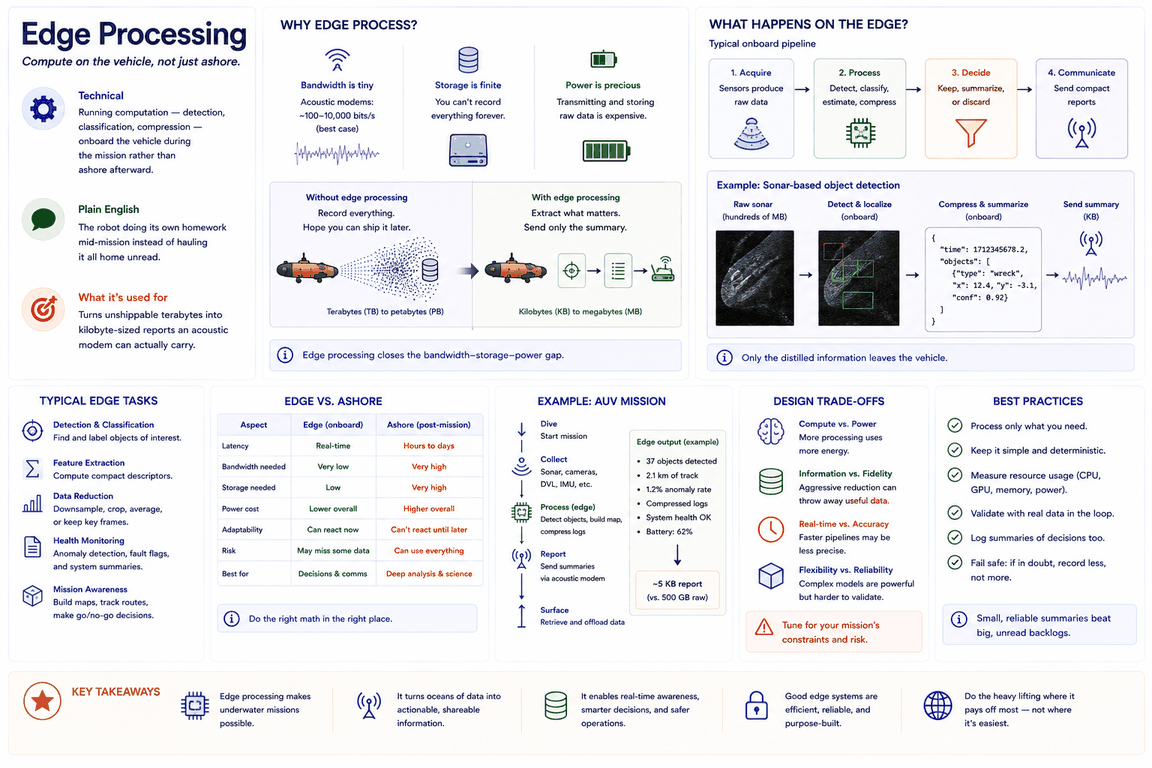
Technical
Running computation — detection, classification, compression — onboard the vehicle during the mission rather than ashore afterward.
Plain English
The robot doing its own homework mid-mission instead of hauling it all home unread.
What it's used for
Turns unshippable terabytes into kilobyte-sized reports an acoustic modem can actually carry.
EKF / sensor fusion
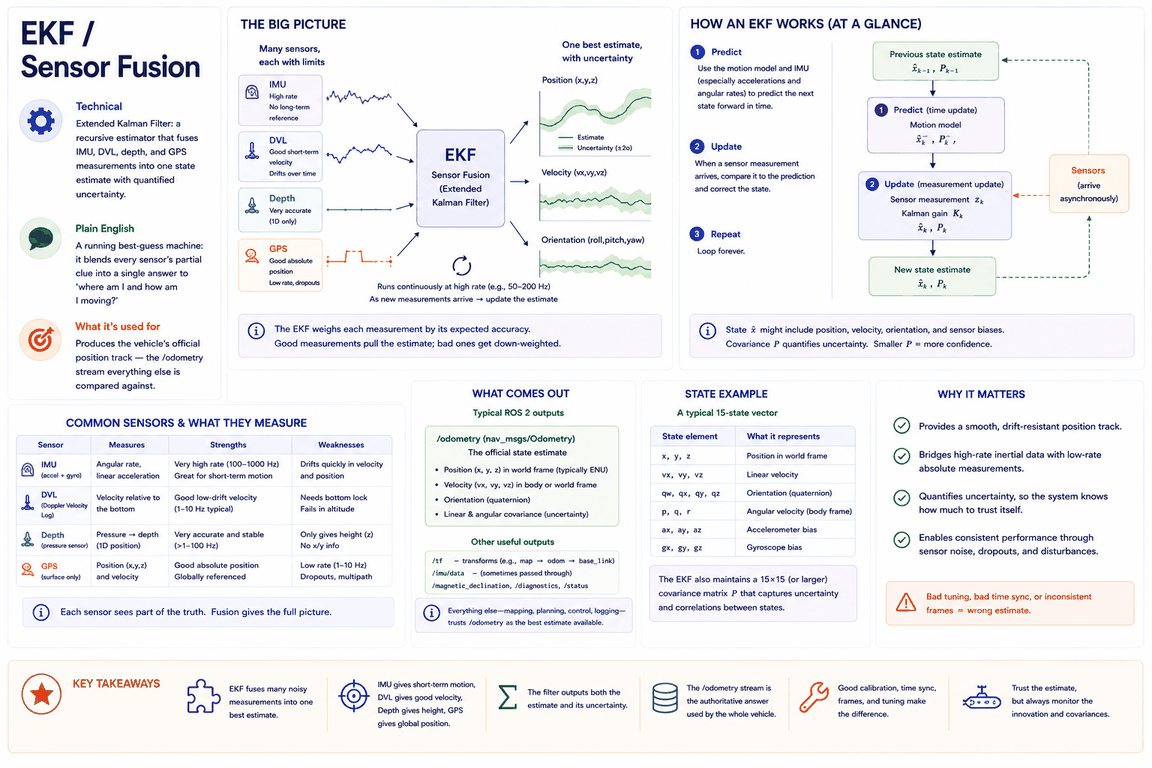
Technical
Extended Kalman Filter: a recursive estimator that fuses IMU, DVL, depth, and GPS measurements into one state estimate with quantified uncertainty.
Plain English
A running best-guess machine: it blends every sensor's partial clue into a single answer to 'where am I and how am I moving?'
What it's used for
Produces the vehicle's official position track — the /odometry stream everything else is compared against.
ENU vs NED
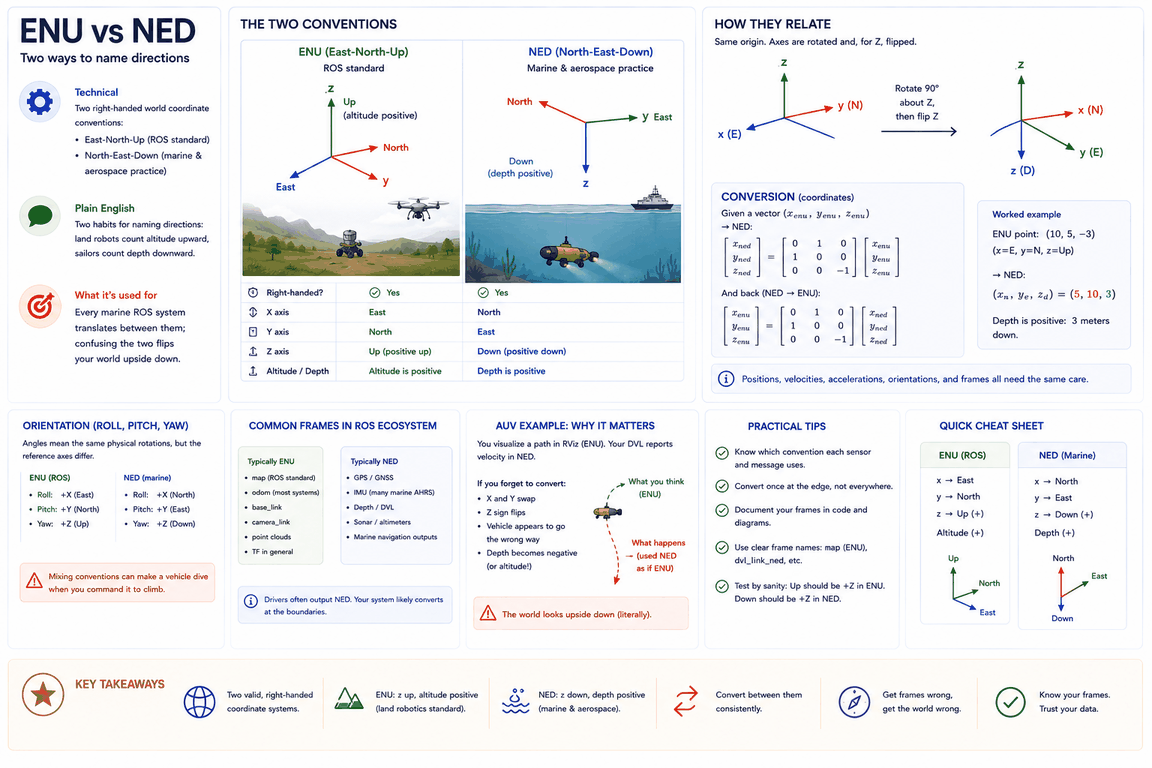
Technical
Two right-handed world coordinate conventions: East-North-Up (the ROS standard; z points up) and North-East-Down (marine and aerospace practice; z points down, so depth is positive).
Plain English
Two habits for naming directions: land robots count altitude upward, sailors count depth downward.
What it's used for
Every marine ROS system translates between them; confusing the two flips your world upside down.
Hz (hertz)
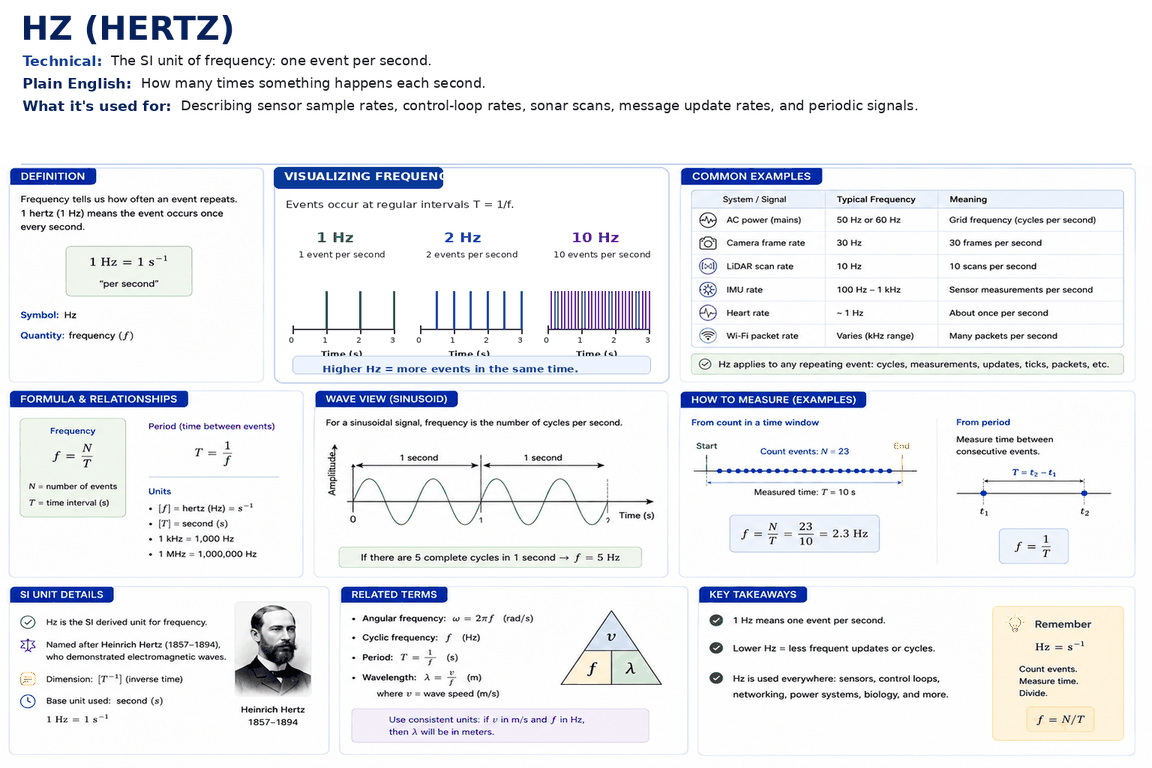
Technical
The SI unit of frequency: one event per second.
Plain English
How many times per second something happens — 200 Hz means 200 updates every second.
What it's used for
The natural unit for sensor publish rates, and the reason different topics accumulate wildly different row counts.
IMU (inertial measurement unit)
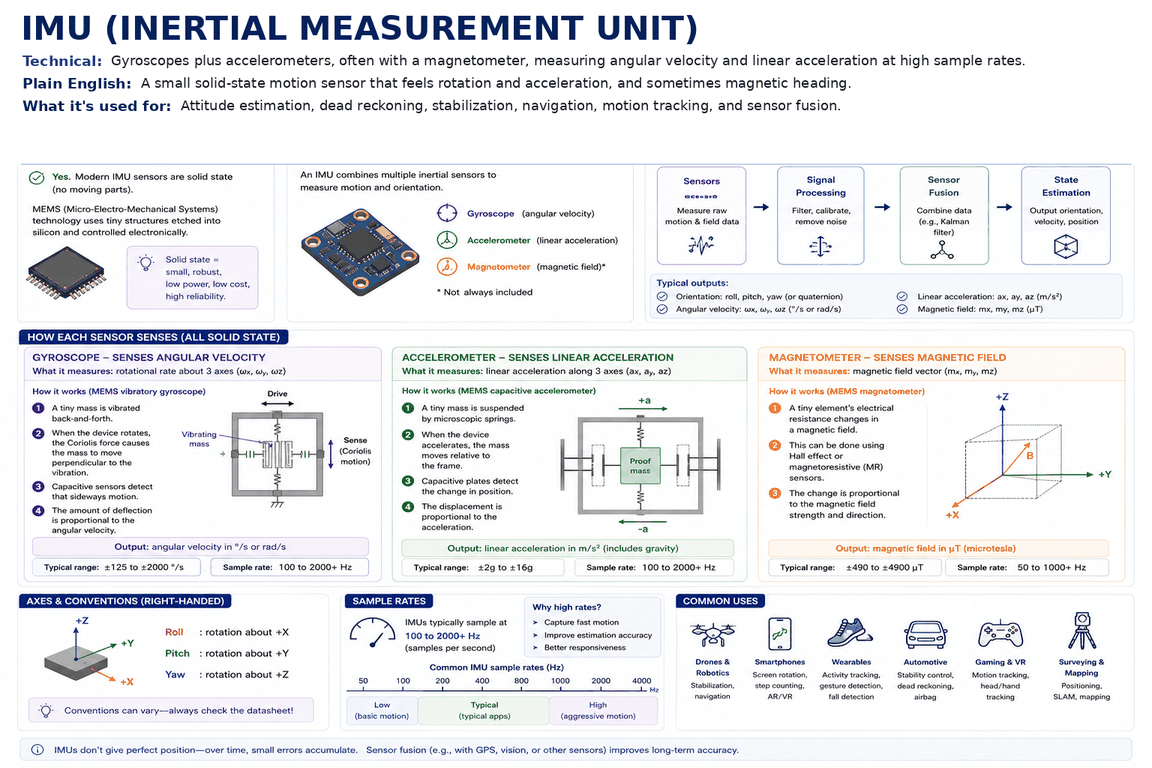
Technical
Gyroscopes plus accelerometers (often with a magnetometer) measuring angular velocity and linear acceleration at hundreds of samples per second. Published as sensor_msgs/Imu, which carries orientation, angular velocity and linear acceleration, each with its own covariance matrix.
Plain English
The robot's inner ear: it feels every turn and bump, hundreds of times per second.
What it's used for
The backbone of attitude estimation and dead-reckoning navigation.
LaserScan
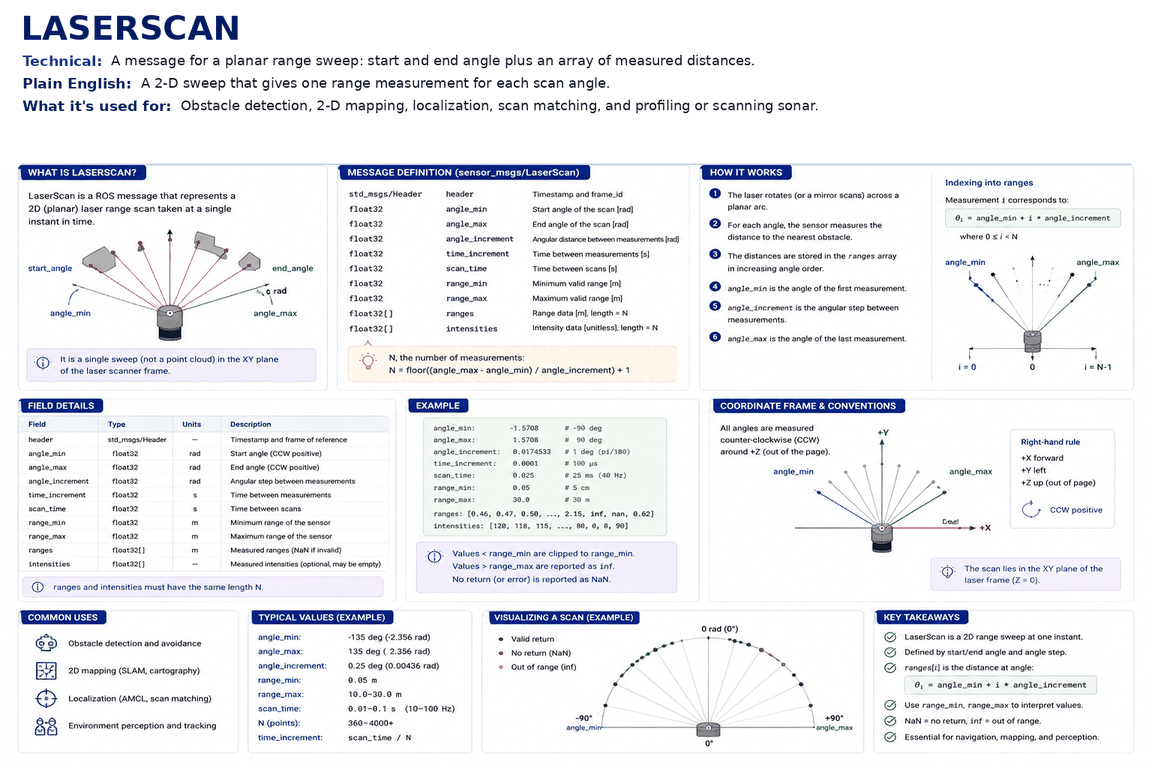
Technical
sensor_msgs/LaserScan describes a planar range sweep: start and end angle plus an array of measured distances.
Plain English
A fan of distance measurements swept across a plane, like the radar sweep in a submarine movie.
What it's used for
Designed for ground-robot lidars; underwater it carries profiling and scanning sonar sweeps.
message
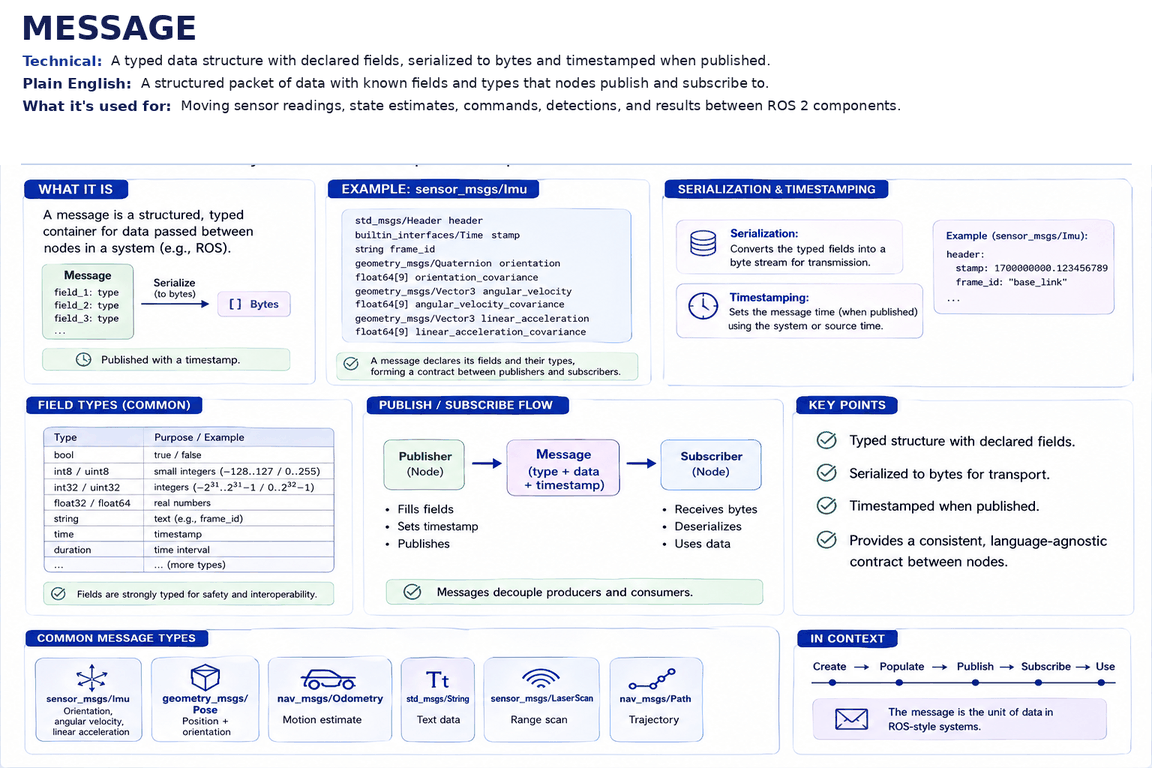
Technical
A typed data structure with declared fields (for example sensor_msgs/Imu), serialized to bytes and timestamped when published.
Plain English
One 'text' in the group chat: a small labeled package of numbers with a time attached.
What it's used for
The atomic unit of everything a robot records; analysis starts by decoding these.
multibeam echosounder
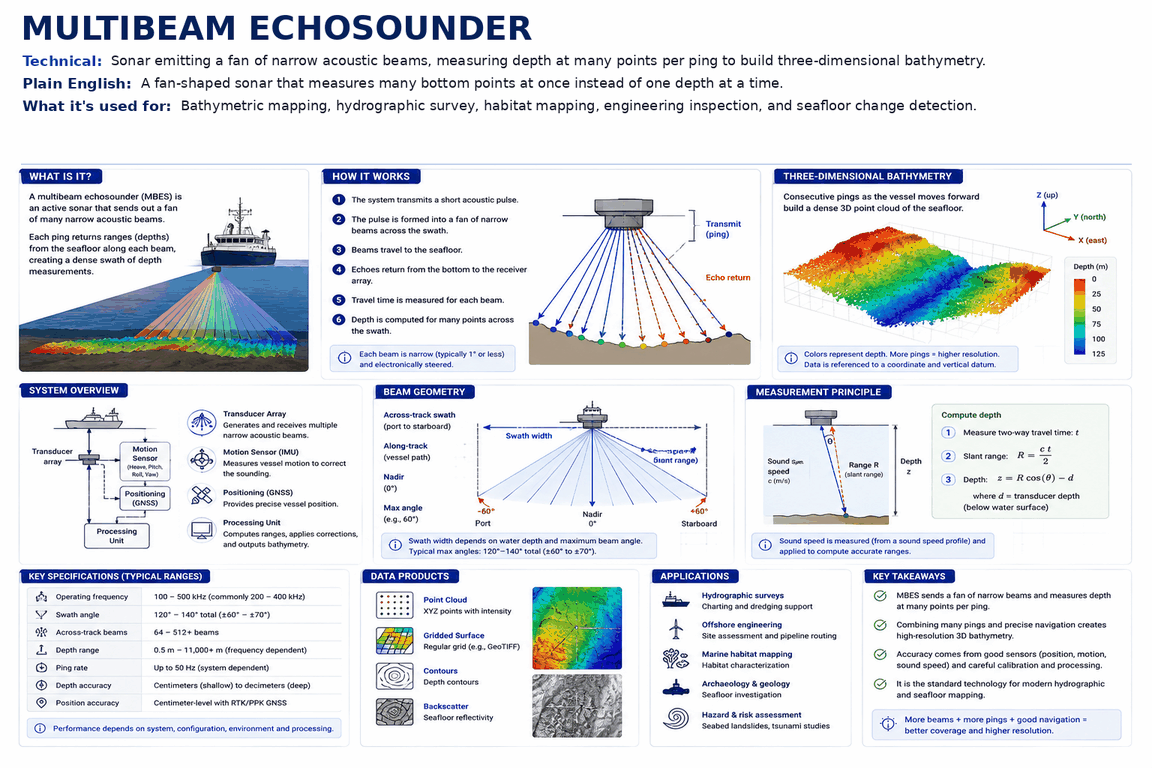
Technical
Sonar emitting a fan of narrow acoustic beams, measuring depth at many points per ping to build three-dimensional bathymetry.
Plain English
Measures water depth at hundreds of points at once, sweeping out a 3-D map of the bottom.
What it's used for
Seafloor mapping and nautical charting.
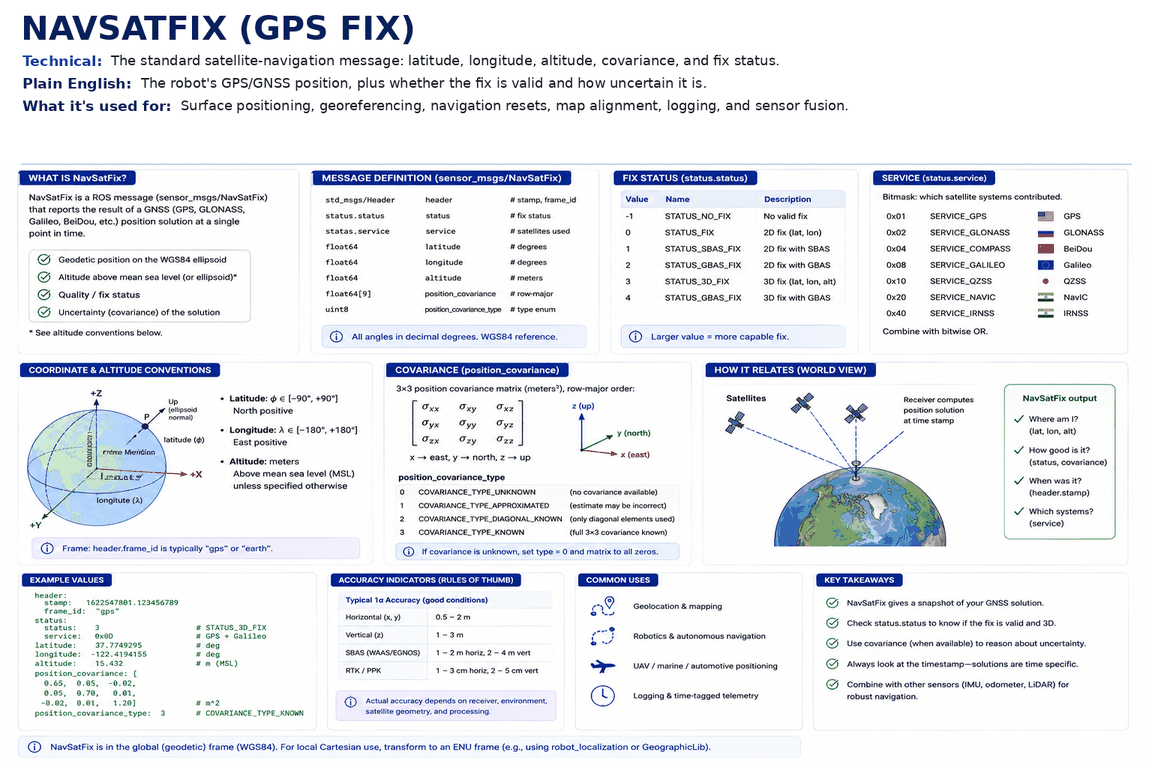
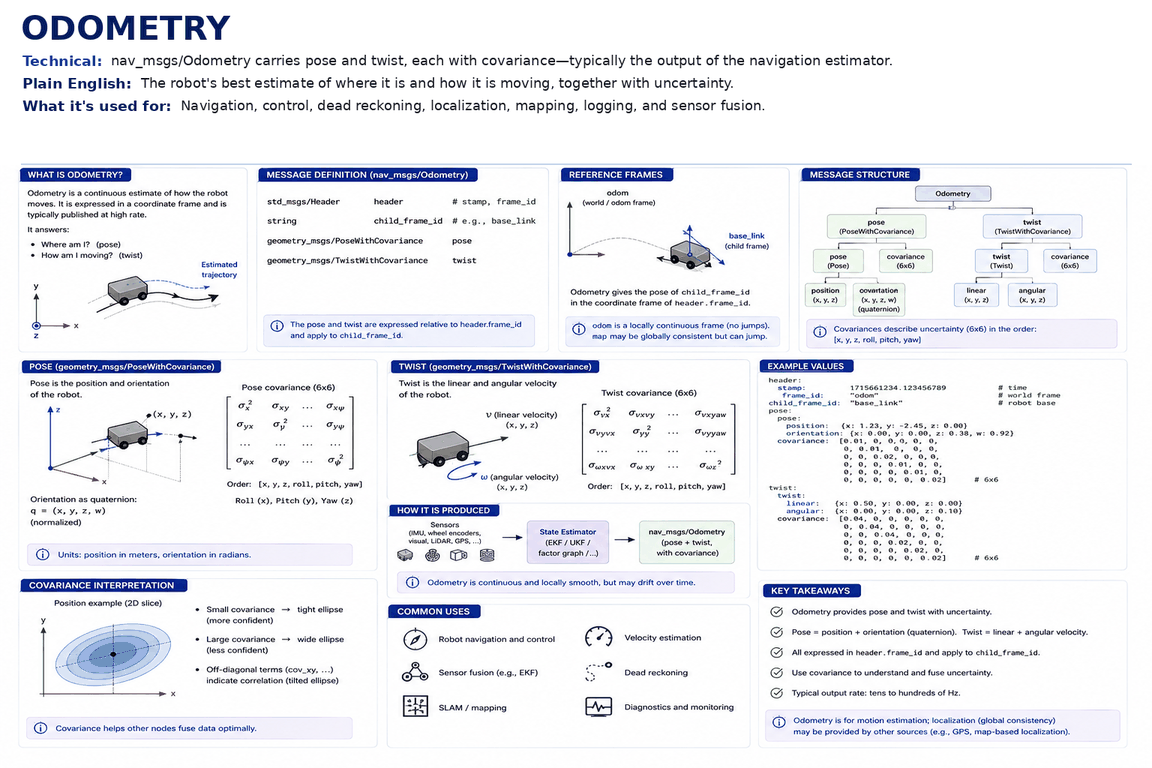
odometry
Technical
nav_msgs/Odometry carries pose (position and orientation) and twist (linear and angular velocity), each with covariance — typically the output of the navigation estimator.
Plain English
The robot's diary entry, written many times a second: 'here's where I think I am and how I'm moving.'
What it's used for
The reference track every other measurement is plotted against.
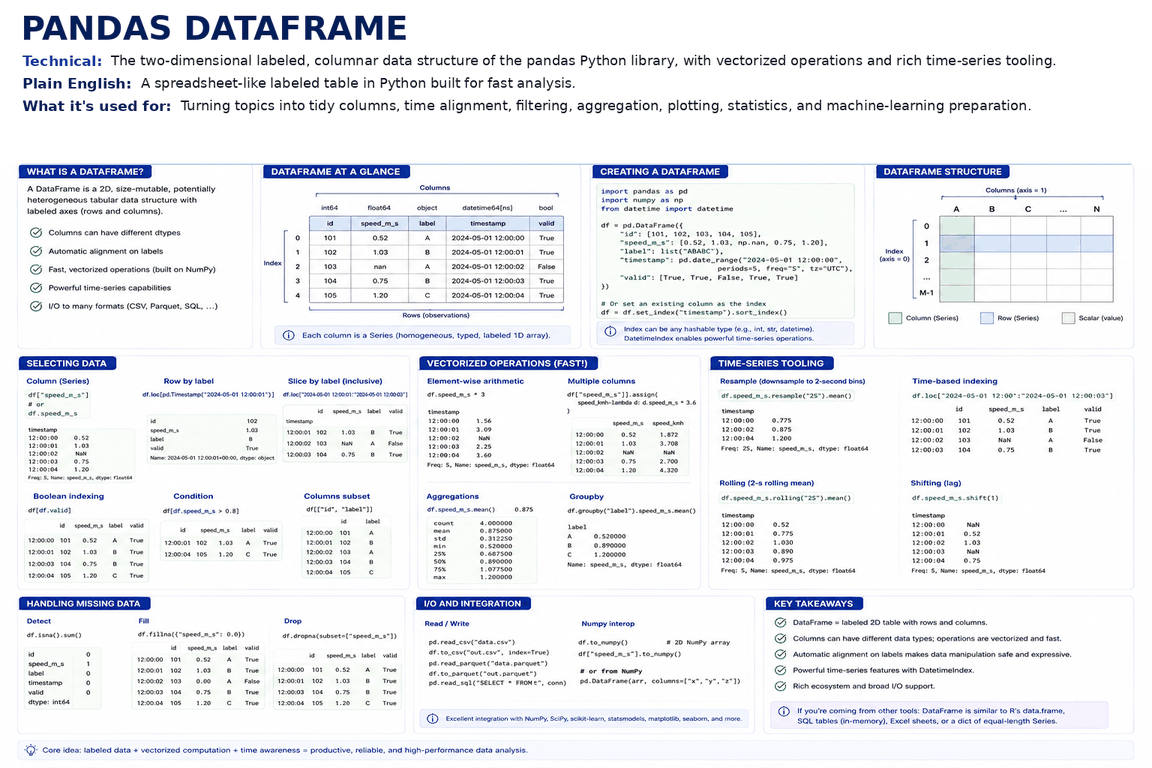
pandas DataFrame
Technical
The two-dimensional labeled, columnar data structure of the pandas Python library, with vectorized operations and rich time-series tooling.
Plain English
A spreadsheet living inside Python: rows, named columns, and superpowers.
What it's used for
The standard workbench for analyzing tabular and time-series data — mission recordings included.
PointCloud2
Technical
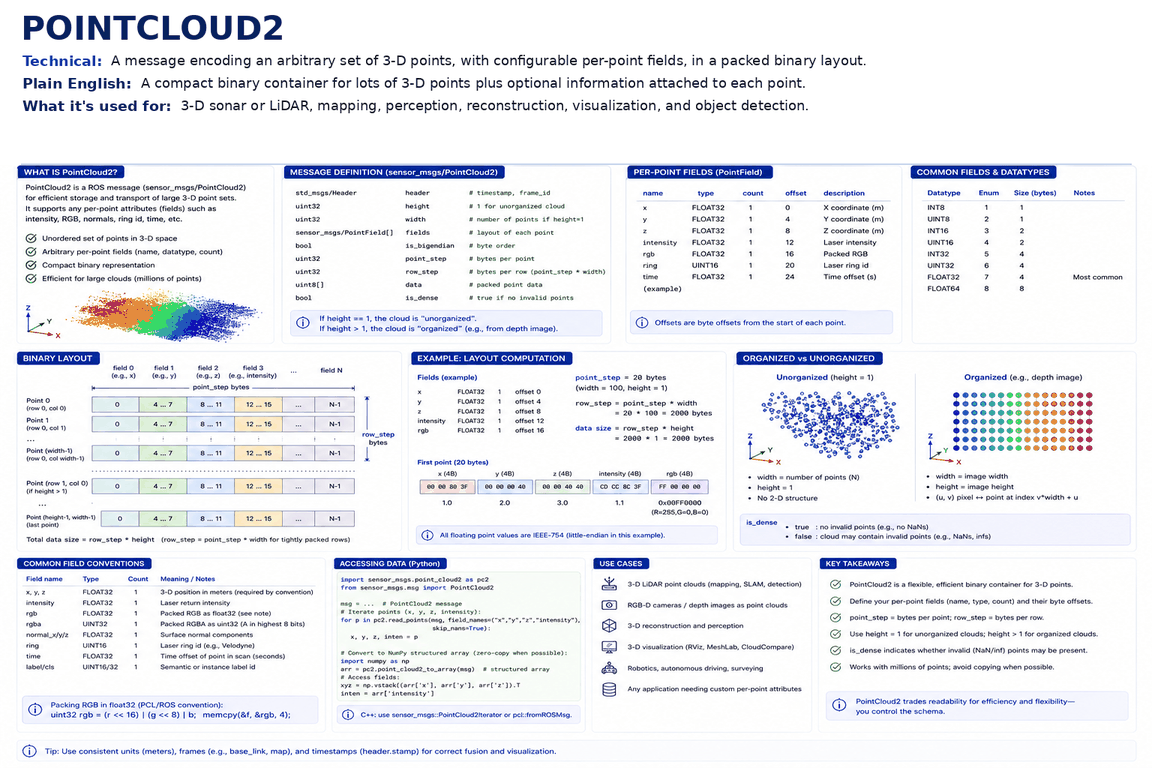
sensor_msgs/PointCloud2 encodes an arbitrary set of 3-D points, with configurable per-point fields, in a packed binary layout.
Plain English
A cloud of dots in 3-D space — a spray-paint scan of the surroundings.
What it's used for
How multibeam sonar and 3-D scanners deliver their measurements.
post-mission analysis (PMA)
Technical
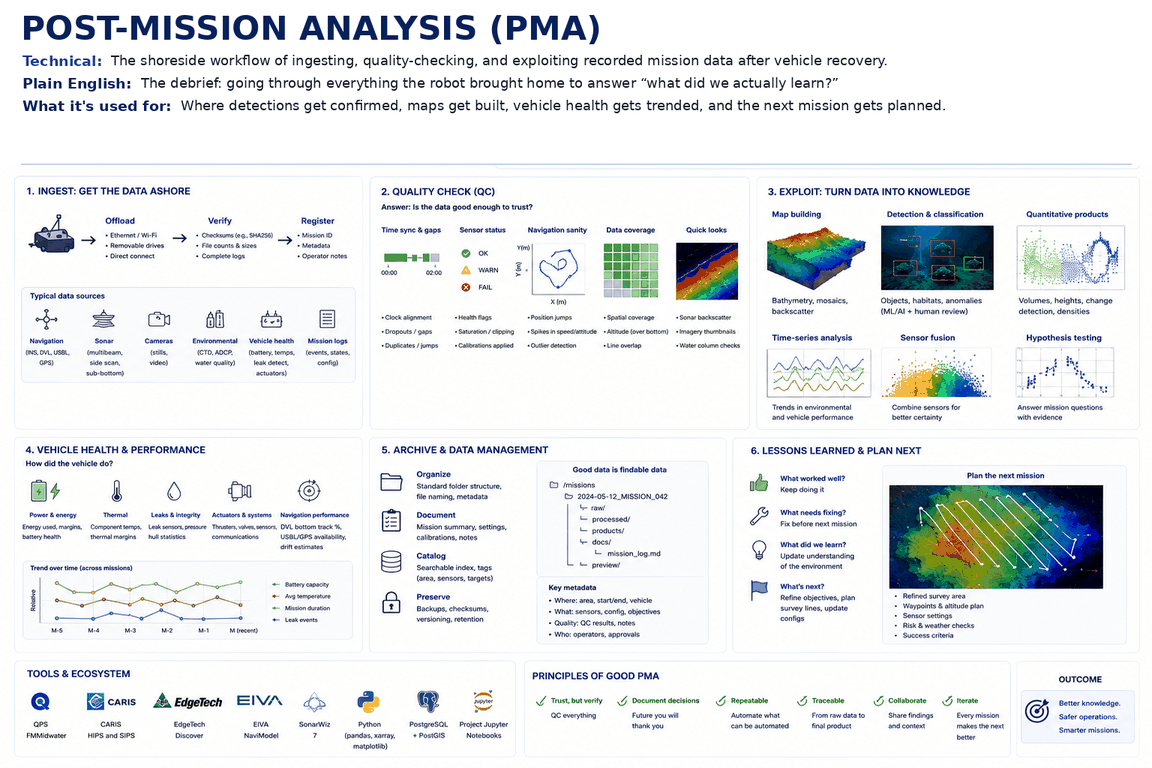
The shoreside workflow of ingesting, quality-checking, and exploiting recorded mission data after vehicle recovery.
Plain English
The debrief: going through everything the robot brought home to answer 'what did we actually learn?'
What it's used for
Where detections get confirmed, maps get built, vehicle health gets trended, and the next mission gets planned.
pressure / depth sensor
Technical
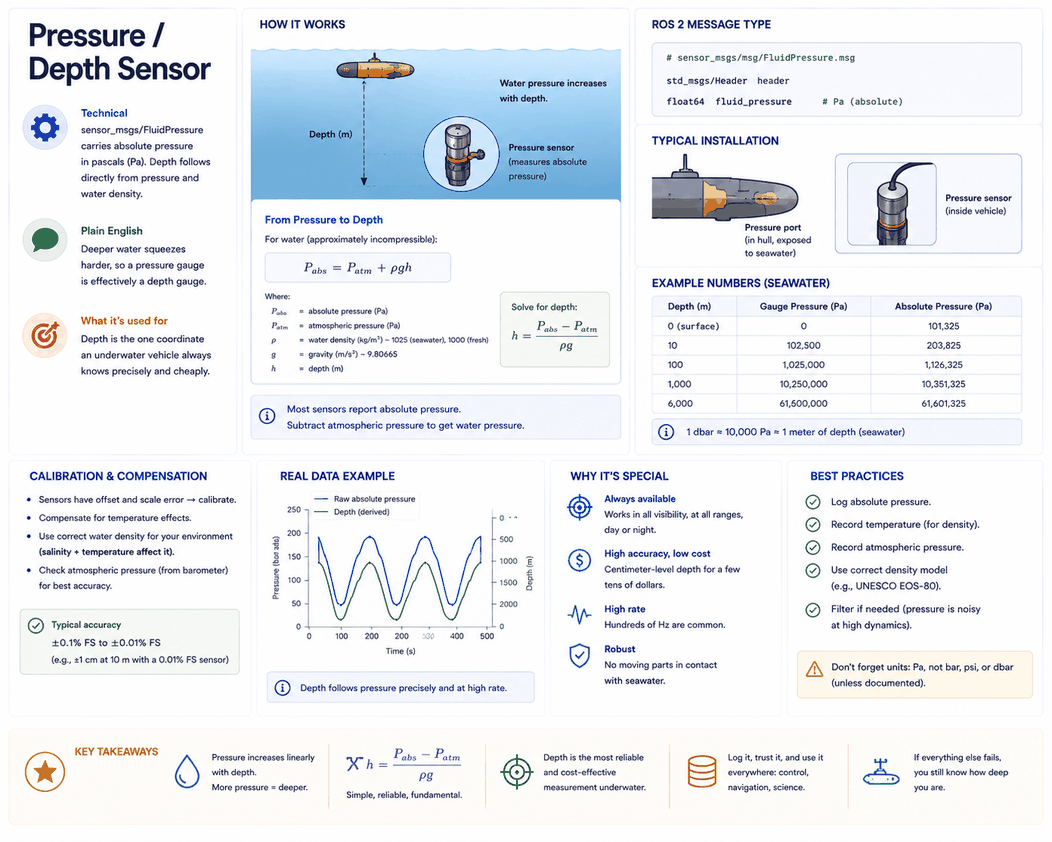
sensor_msgs/FluidPressure carries absolute pressure in pascals; depth follows directly from pressure and water density.
Plain English
Deeper water squeezes harder, so a pressure gauge is effectively a depth gauge.
What it's used for
Depth is the one coordinate an underwater vehicle always knows precisely and cheaply.
ROS 2 (Robot Operating System)
Technical
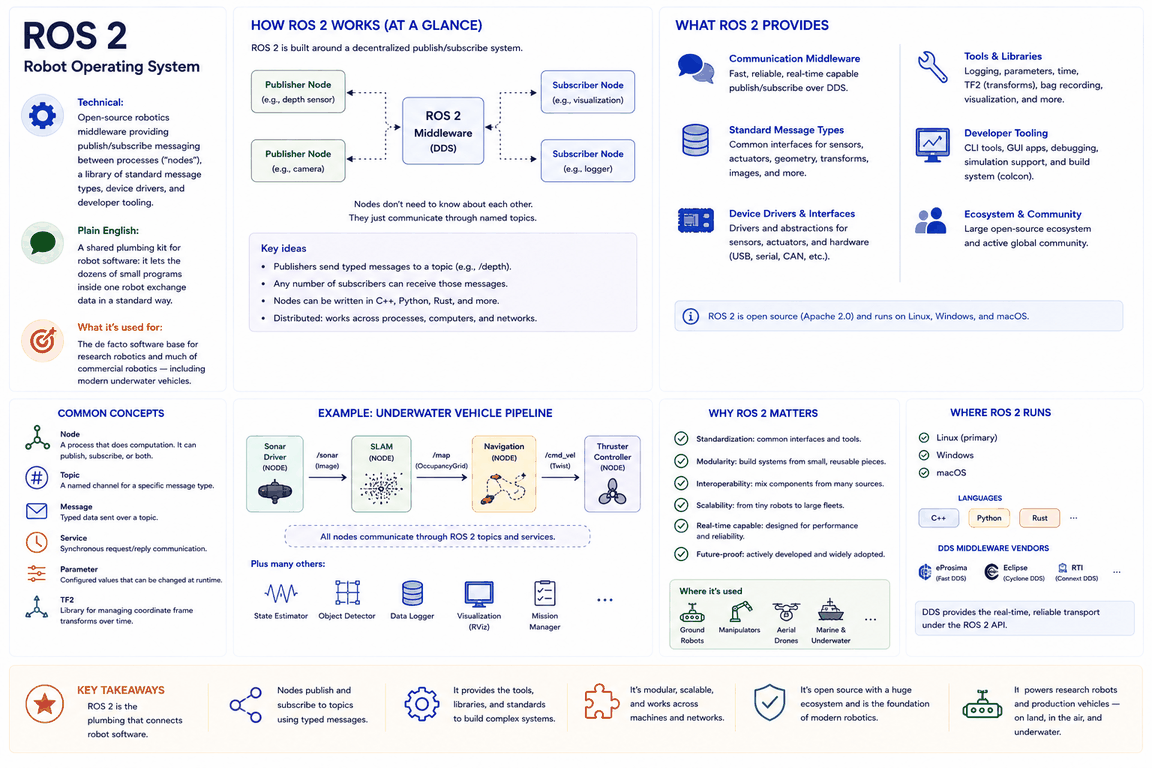
Open-source robotics middleware providing publish/subscribe messaging between processes ('nodes'), a library of standard message types, device drivers, and developer tooling.
Plain English
A shared plumbing kit for robot software: it lets the dozens of small programs inside one robot exchange data in a standard way.
What it's used for
The de facto software base for research robotics and much of commercial robotics — including modern underwater vehicles.
rosbag1 vs rosbag2
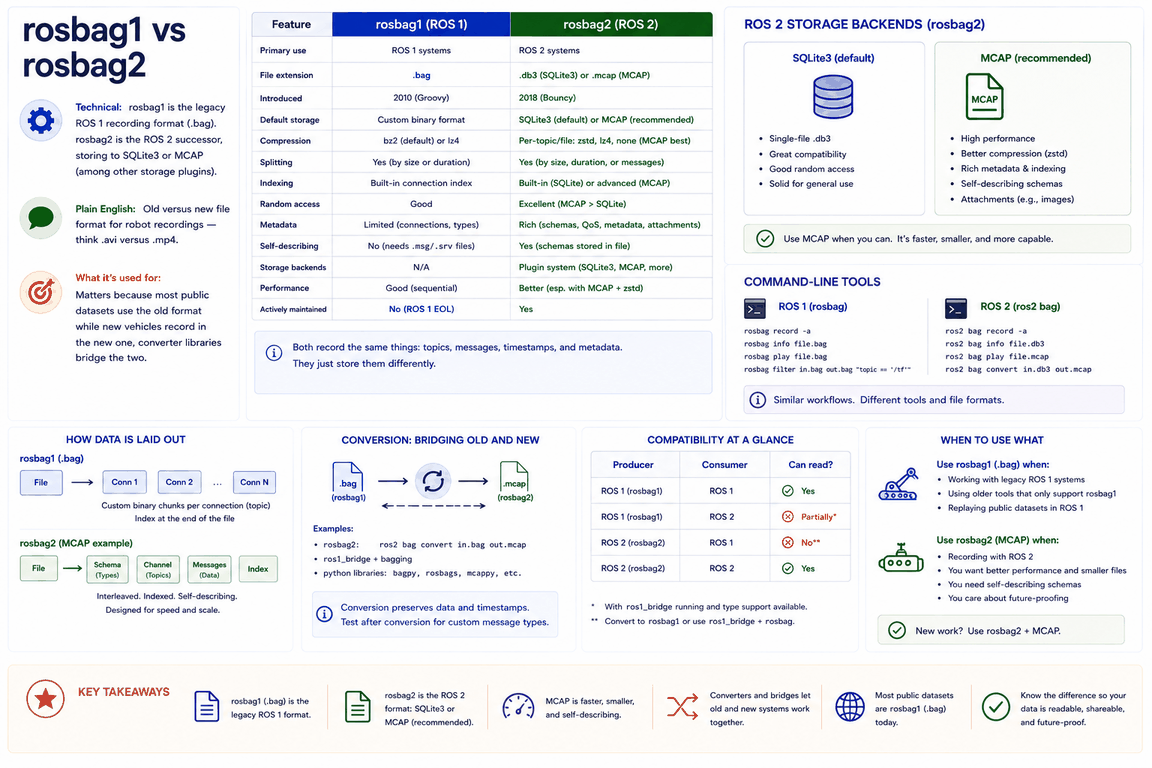
Technical
rosbag1 is the legacy ROS 1 recording format (.bag); rosbag2 is the ROS 2 successor, storing to SQLite or MCAP.
Plain English
Old versus new file format for robot recordings — think .avi versus .mp4.
What it's used for
Matters because most public datasets use the old format while new vehicles record in the new one; converter libraries bridge the two.
schema / self-describing
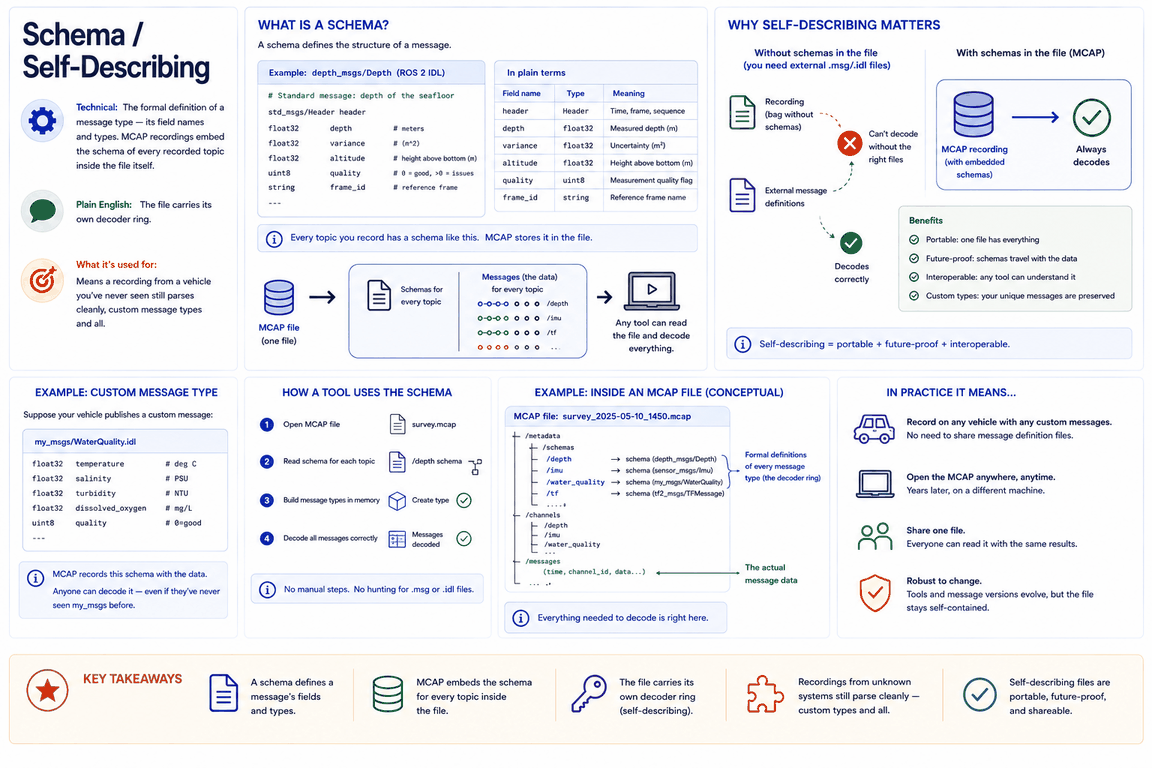
Technical
The formal definition of a message type — its field names and types. MCAP recordings embed the schema of every recorded topic inside the file itself.
Plain English
The file carries its own decoder ring.
What it's used for
Means a recording from a vehicle you've never seen still parses cleanly, custom message types and all.
side-scan sonar
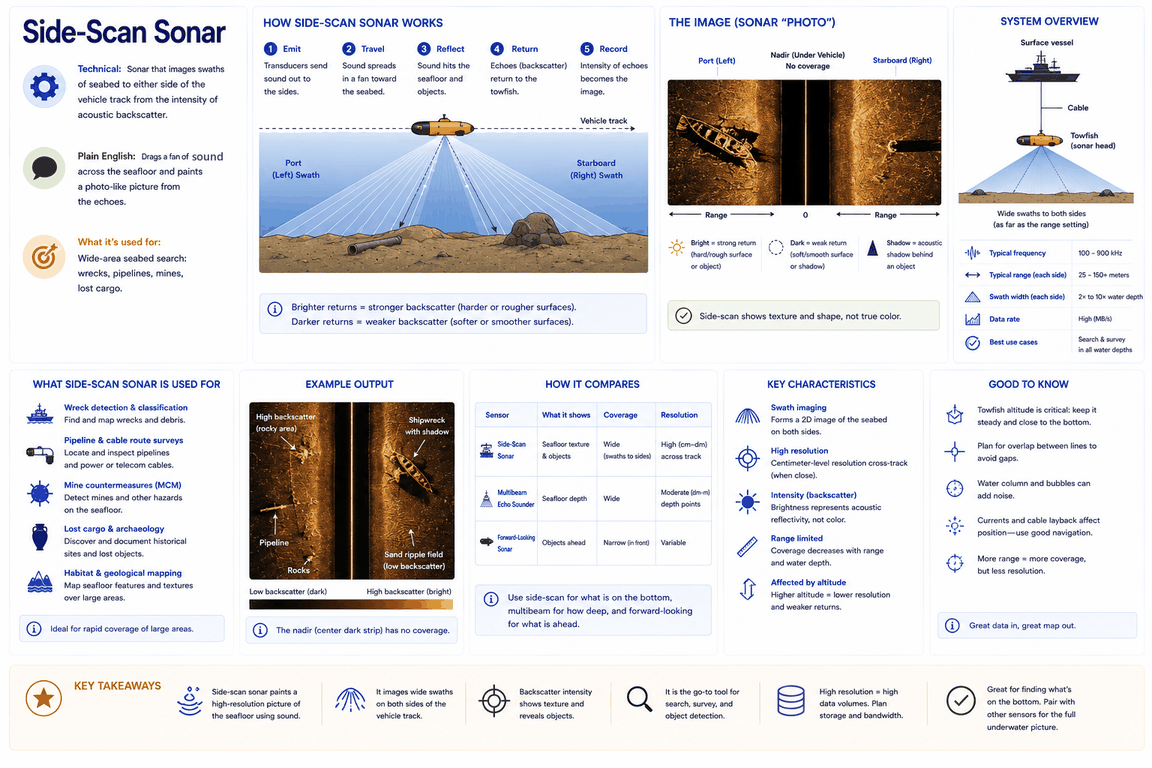
Technical
Sonar that images swaths of seabed to either side of the vehicle track from the intensity of acoustic backscatter.
Plain English
Drags a fan of sound sideways across the seafloor and paints a photo-like picture from the echoes.
What it's used for
Wide-area seabed search: wrecks, pipelines, mines, lost cargo.
SLAM
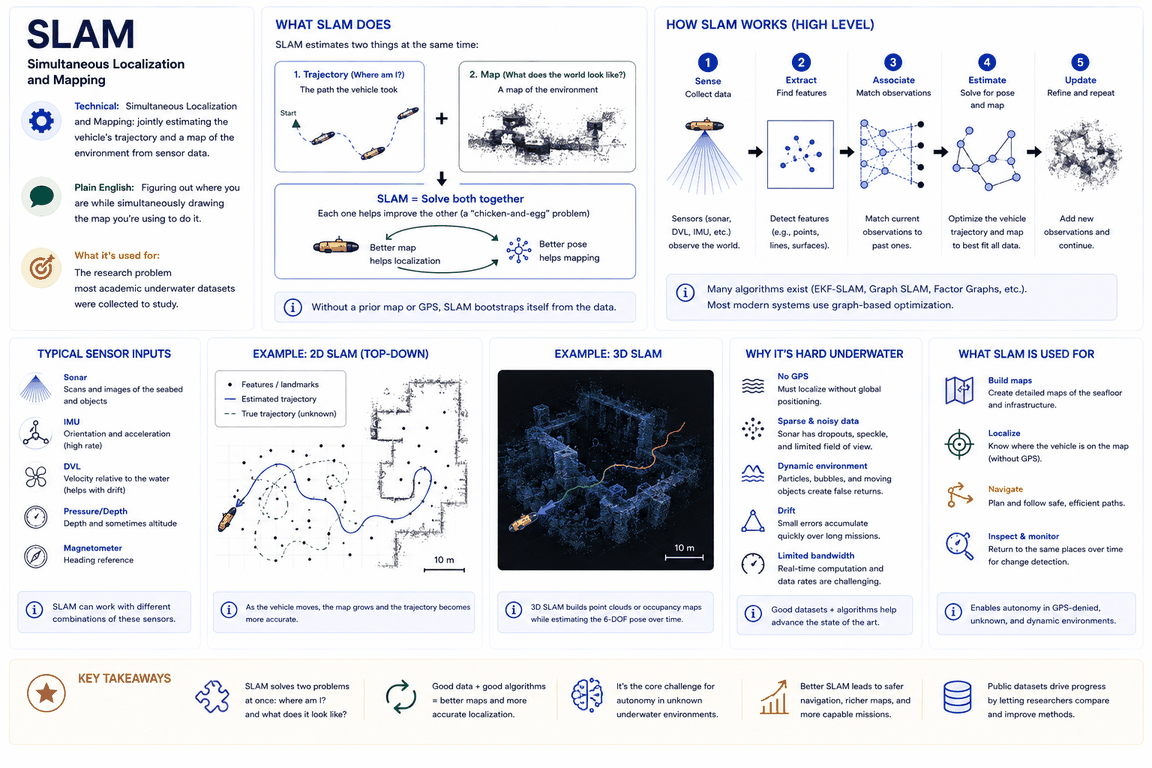
Technical
Simultaneous Localization and Mapping: jointly estimating the vehicle's trajectory and a map of the environment from sensor data.
Plain English
Figuring out where you are while simultaneously drawing the map you're using to do it.
What it's used for
The research problem most academic underwater datasets were collected to study.
sonar
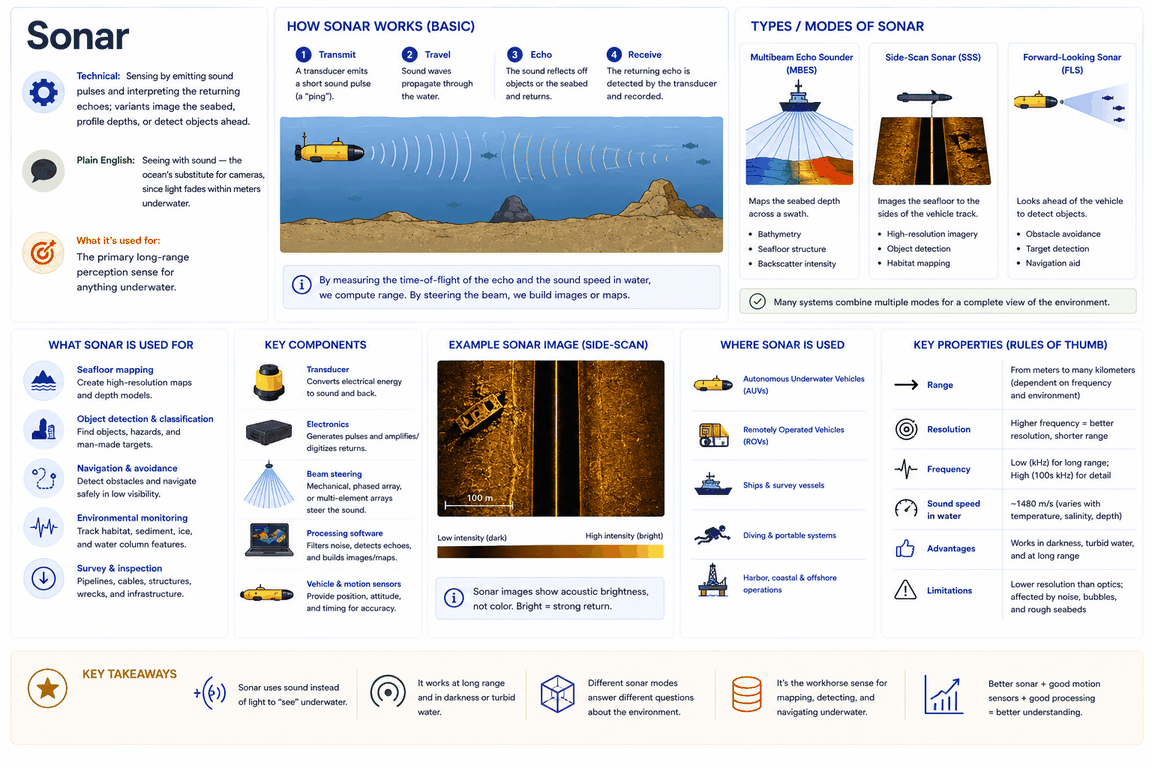
Technical
Sensing by emitting sound pulses and interpreting the returning echoes; variants image the seabed, profile depths, or detect objects ahead.
Plain English
Seeing with sound — the ocean's substitute for cameras, since light fades within meters underwater.
What it's used for
The primary long-range perception sense for anything underwater.
synthetic-aperture sonar (SAS)
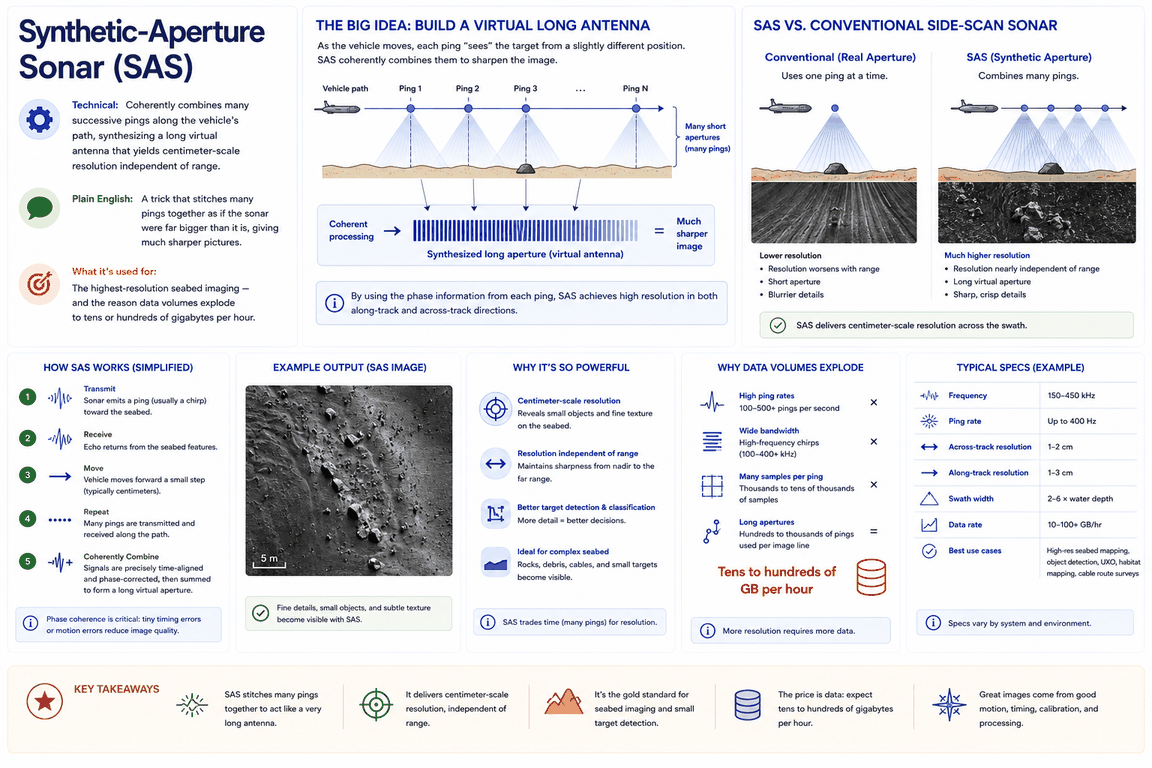
Technical
Coherently combines many successive pings along the vehicle's path, synthesizing a long virtual antenna that yields centimeter-scale resolution independent of range.
Plain English
A trick that stitches many pings together as if the sonar were far bigger than it is, giving much sharper pictures.
What it's used for
The highest-resolution seabed imaging — and the reason data volumes explode to tens or hundreds of gigabytes per hour.
telemetry
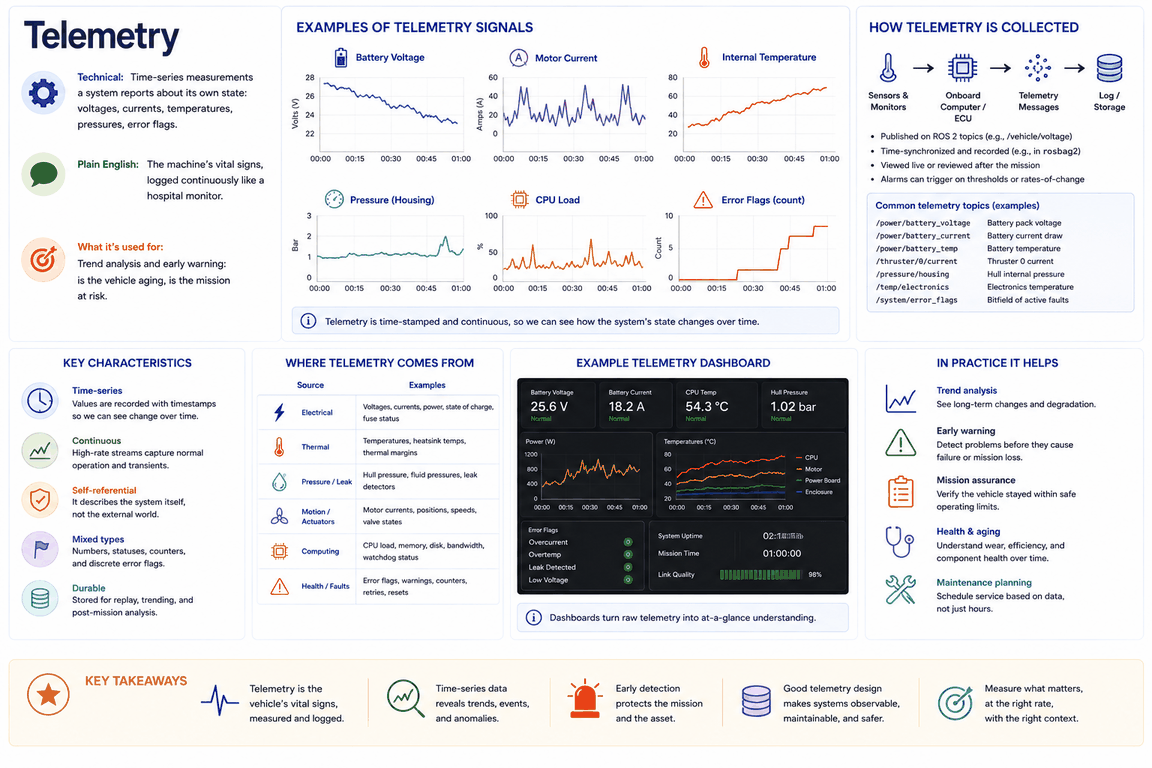
Technical
Time-series measurements a system reports about its own state: voltages, currents, temperatures, pressures, error flags.
Plain English
The machine's vital signs, logged continuously like a hospital monitor.
What it's used for
Trend analysis and early warning: is the vehicle aging, is the mission at risk.
tf2 frame tree
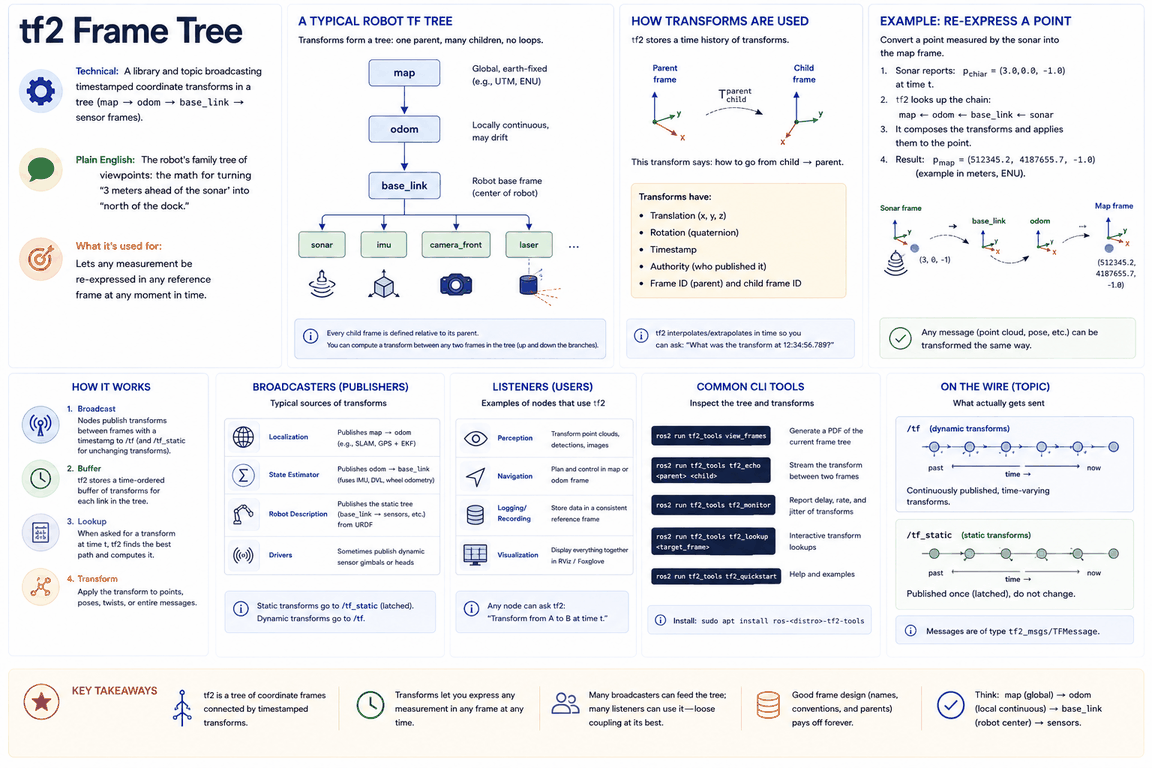
Technical
A library and topic broadcasting timestamped coordinate transforms in a tree (map → odom → base_link → sensor frames). The wire format is tf2_msgs/TFMessage; the Python side is tf2_ros.
Plain English
The robot's family tree of viewpoints: the math for turning '3 meters ahead of the sonar' into 'north of the dock.'
What it's used for
Lets any measurement be re-expressed in any reference frame at any moment in time.
topic
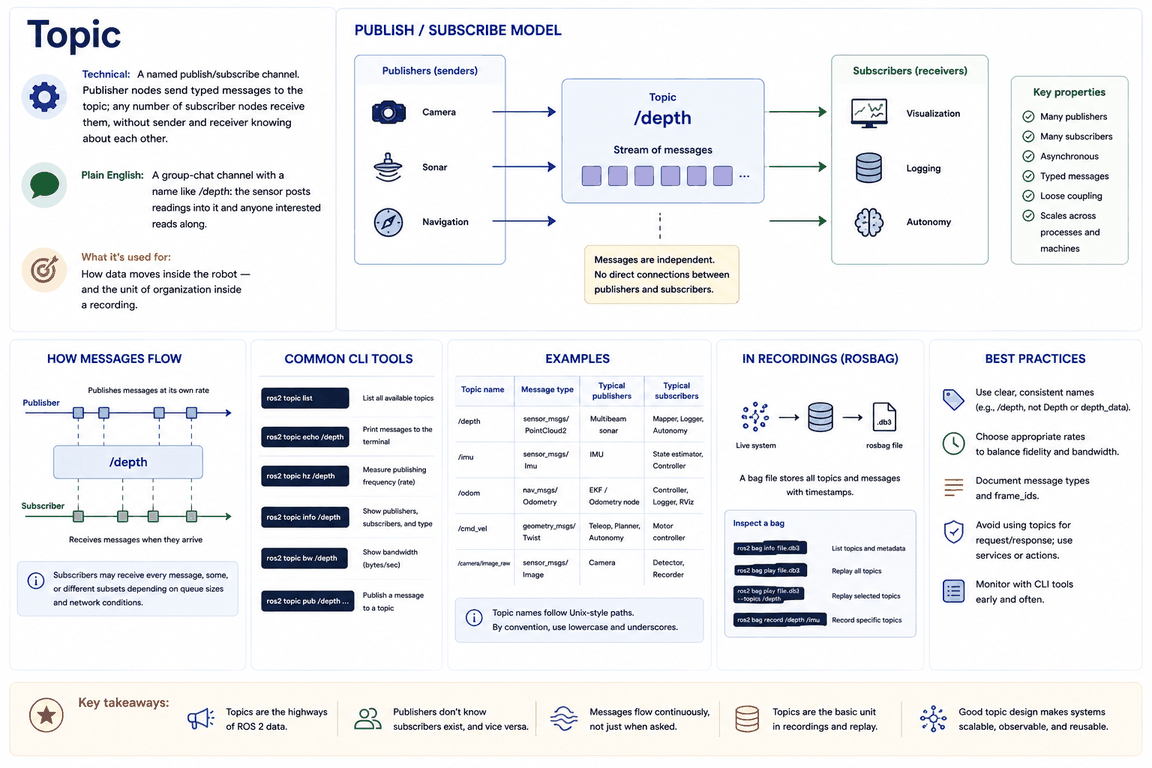
Technical
A named publish/subscribe channel. Publisher nodes send typed messages to the topic; any number of subscriber nodes receive them, without sender and receiver knowing about each other.
Plain English
A group-chat channel with a name like /depth: the sensor posts readings into it and anyone interested reads along.
What it's used for
How data moves inside the robot — and the unit of organization inside a recording.
vendor formats
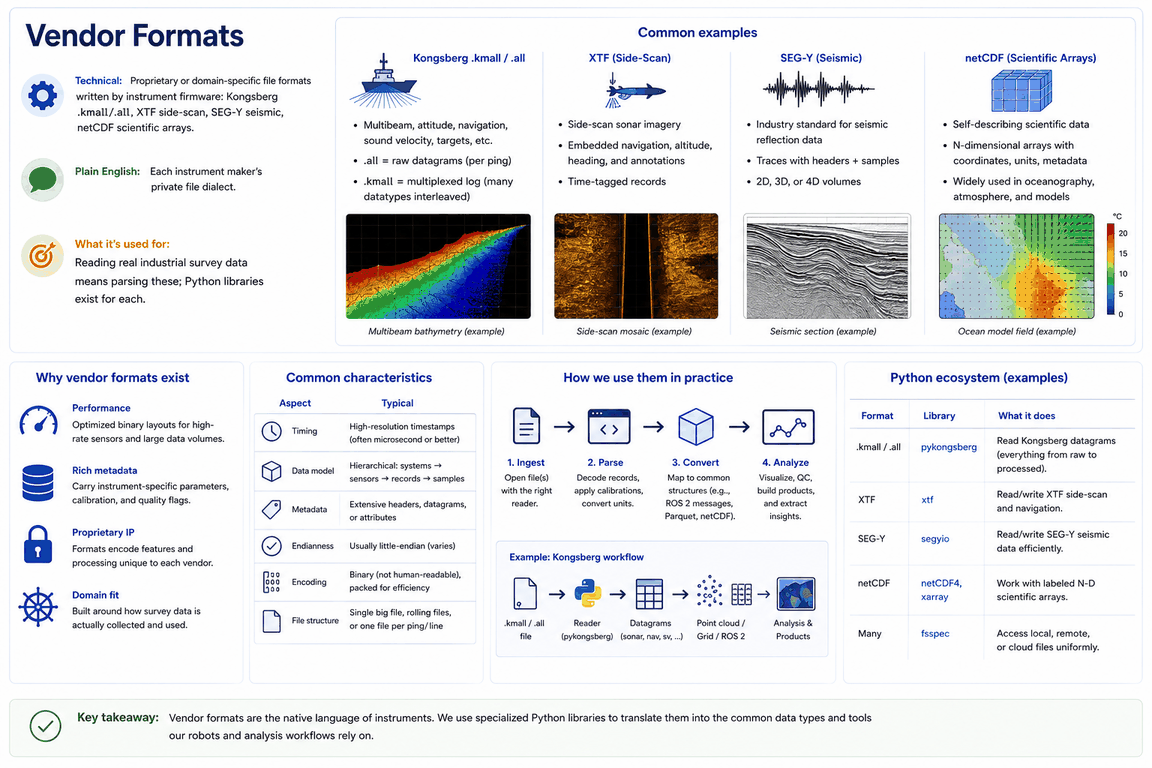
Technical
Proprietary or domain-specific file formats written by instrument firmware: Kongsberg .kmall/.all, XTF side-scan, SEG-Y seismic, netCDF scientific arrays.
Plain English
Each instrument maker's private file dialect.
What it's used for
Reading real industrial survey data means parsing these; Python libraries exist for each.